Education or Indoctrination?
Speaking from outside the system, for the children, teachers and others who are inside it.
Education or Indoctrination?
Speaking from outside the system, for the children, teachers and others who are inside it.
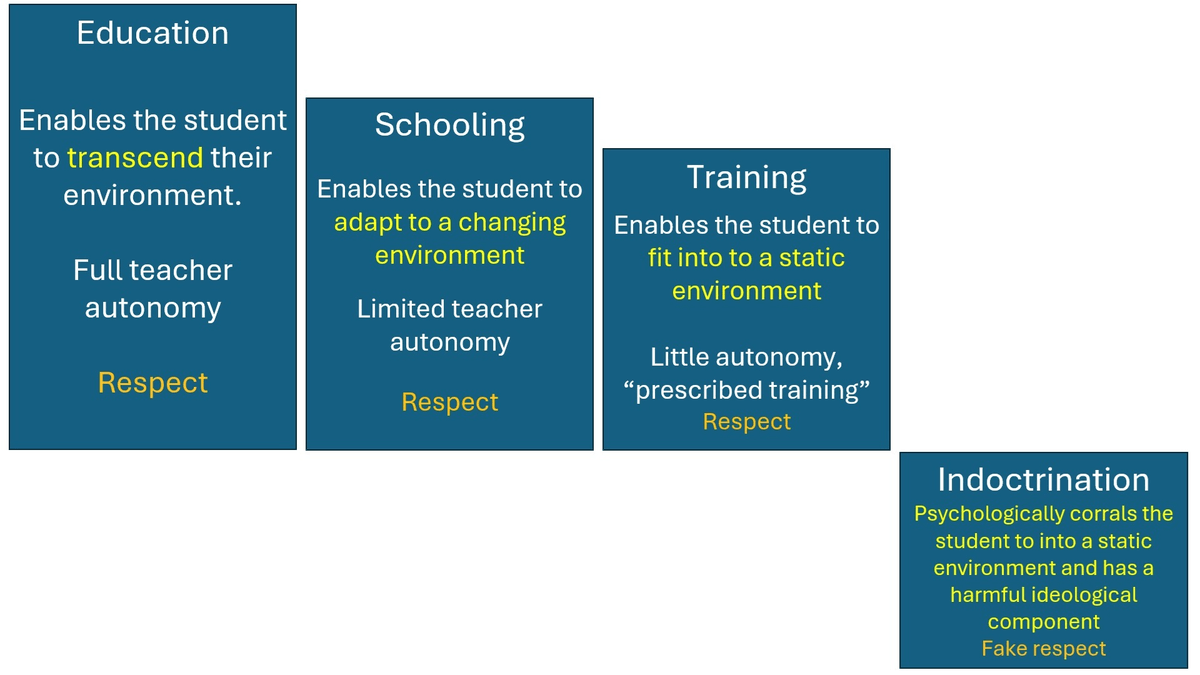
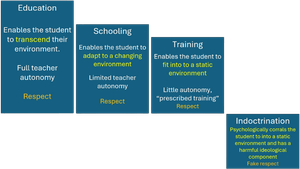
Over the last 50 years, the New Zealand education system has been increasingly trainified, meaning that the military instructional systems design approach (ISD) has been imposed upon teachers and children in our schools, without saying so.
Since 2018, the trainification of education has descended even further, into indoctrination.
Teacher training used to teach trainee teachers how to teach children. But now it trains trainee teachers how to become instructors, and how to to 'deliver content' in accordance with learning objectives, which have been written by someone else outside of their classrooms. But because they are still called 'teachers', and because the instruction is still called 'education', and because it is always framed as advances in 'the science of learning', the teachers themselves don't see it, the employees in the Ministry of Education don't see it, the employees of UNESCO don't see it, and people generally don't see it. Everyone knows that our children are suffering terribly, and that there's a so-called 'mental health crisis', and that teachers are suffering, and leaving, and that classrooms are extremely stressful places with disruptive students.... but no-one seems to know why... but I think I know why.
Why am I qualified to comment? Because:
- I have a BSoc Sci majoring in Education with a focus on the Philosophy of Education (Waikato 92). This means that I understand the first principles of education, from an analytical philosophical perspective, in the tradition of R.S. Peters. This means that I know what Education is and what it isn't. I have specific criteria in my mind when I consider whether something can be justifiably called 'education', or not.
- I'm also an RNZ Navy-trained instructional designer (approx 1997), with years of experience developing trade training materials, for ITOs and a polytechnic, which means that I know instructionally designed training materials when I see them, and I can quickly identify what has been done well (from a training point of view) and what hasn't been done well.
- I also have a Post Graduate Diploma in Second Language Teaching (Waikato '93) with 5 years experience in teaching English language to young adults, in private language schools. This means that I understand what it is to have a classroom of students, and how to set up classroom dynamics to enable teaching of the subject.
- I'm also Mum to two children (now 20 and 15), who have been harmed by contemporary 'education'. And it's not just my children who have been harmed, it's so many children. The harm is what has motivated me to do this work. We need to prevent the harm and begin the restoration.
- Also- I haven't been formed by teacher training in New Zealand- and this I believe gives me a valuable outsiders point of view.
- And, my own formative education includes:
* a PNEU school called Selwyn House, in Christchurch New Zealand, when I was 6;
* a public school called Welborne Avenue Public School, in Kingston Ontario, Canada, when I was 7 to 13;
* a private girl's school called Wychwood Girl's School, in Oxford England, when I was 14; and
* the oldest highschool in Canada, called Kingston Collegiate and Vocational Institute, in Kingston Ontario, when I was 15 to 16, and
* a private girl's school in Christchurch, New Zealand, called Rangi Ruru Girls' School, when I was 16 to 18.
In other words, I've had the privilege of experiencing an international true education, before trainification was imposed upon any of my teachers or classrooms. That background, of deeply knowing what true education is, especially when contrasted to what I see has been done to my and other children here in New Zealand, is a critical backdrop for what I want to say in this website.
My mission is to show the reader what has happened in 'education' over the last 50 years. If you agree with what I'm presenting, then perhaps we can all begin to identify the true causes of the suffering and undo the errors which have been made, and restore true education to our schools.
What's wrong with applying the ISD model to children in schools?
The ISD approach to training presupposes a deficit in the trainee. This is okay for an adult who already knows who they are, but when training is imposed upon children, that assumption of a deficit gets conveyed to the children too. For example, to be 'successful', you have to 'complete the learning objectives' and 'demonstrate competency' and get good grades. You're not already whole in the eyes of a trainified system. You have to constantly strive, and it includes stuff that you haven't even wanted to do, in methods that you haven't volunteered to do or agreed to.
Some readers might think, 'but isn't that what school is about?' If you think this, it's because you yourself have been denied the experience of true education and you've been denied any knowledge of the first principles of education, which is called The Philosophy of Education. The Philosophy of Education was removed from teacher training around 1980, all over the English speaking world, at about the same time.
Let's do a quick activity: Have you got a sheet of paper and a pen?
a. Okay so, first, visualise someone you regard as truly educated. Then think carefully about what their qualities and characteristcs are, which lead you to regard them as truly educated. Please write them down on the left side of your paper.
b. Now, visualise 'an uneducated person'. This time think carefully about what their qualities and characteristcs are, which lead you to regard them as uneducated. Write them down on the right side of your paper.
c. Now you have two lists: the qualities and characteristics of being educated, and the qualities and characteristics of being uneducated.
Given that 'educated' expresses the end state of the process of education, and that 'uneducated' expresses what happens to someone who doesn't receive education, then these two lists form the boundaries of what education should be aiming towards and what it should be aiming away from.
Now,
How did it get removed? By re-framing it as 'excessively theoretical' and 'ivory-towered', 'impractical' and 'elitist'. On the 15th May 1980, the Minister for Education Mr Merv Wellington was reported as saying,
"The New Zealand taxpayer has a keen appreciation of the importance of education and has always given realistically. Equally, in a time of general economic stringency (expressed in the contraction of job opportunity) he looks more critically and asks ‘the value for money’ question more often. What he wants and expects is that the primary tasks or basic things are attended to properly;', he expects tangible practical results and is correspondingly intolerant of excessive theory. “ Source
The article doesn't actually say, 'we're removing the Philosophy of Education', but if you know what you're looking at- and if you compare it to the job descriptions in advertisements for lecturers in education from that time, then it's obvious that that's what it means. Note also how 'the taxpayer' is blamed for this change.
The average New Zealander would have though that sounded sensible. The Philosophers of Education could see the implications for society, but their warnings were not listened to.
By pushing The Philosophy of Education out of teacher training, room was made for the psychology of education to take a leadership role. But, while psychologists of education may be earnest in wanting to help children, unless they have also studied The Philosophy of Education, they don't have the critical first principles which are needed to keep 'the ship of education' on course to preserve the sovereignty of children's minds and the sovereignty of the whole country.
And so you see, the psychologists of education weren't taught the first principles of education, but instead thought in utilitarian terms. That means, they thought in terms of 'the purpose and usefulness of education, rather than the more fundamental question of 'what IS education?' They thought along the lines of 'how can we use education to solve the problems of society?' From the point of view of The Philosophy of Education, that is a very dangerous question.
But no-one was listening to the warnings from the philosophers of education.
The removal of The Philosophy of Education from teacher training in 1980 was the first step towards capturing education and manoeuvring it towards what we now see today in 2026: an extremely highly prescripted and structured 'curriculum which installs specific goals in the minds of children. This is the complete opposite of what true Education is about.
In October 2025, the Ministry of Education published a draft curriculum and invited public submissions on it, which closed on the 24th April 2026.
When I read what has been proposed, I didn't see 'education', or a 'curriculum. What I initially saw was extremely intensely pre-scripted training materials.... and when I look even more closely, I don't even see 'training materials'- because the best practices for ISD are not even being met. For example, in instructional systems design, it is standard best practice to activate the trainee's prior knowledge so that the new content can be anchored in their prior knowledge. True training is also always transparent about what it is training the trainee to become; but that is not made known in these materials. Another marker of best practice ISD is that the content will always be referenced to a reputable subject matter expert. This also doesn't happen in the draft materials.
I thought to myself, well, it's not Education - which means arguably that there are legal problems when considered in terms of the Education and Training Act. And, it's not even best practice training, which raises more questions about who and how it was designed and for what purpose. What is it then?
I wanted to know what these materials are actually doing to our children.
So, I built an analytical tool in Claude AI called 'INESCAPABLE', which is anchored in The Laws of Thought and Boolean algebra. You can view INESCAPABLE in a separate tab.
So far, I've just done the Health and Physical Education (HPE) learning areas, for years 1 to 10. The results are below.
This website is a work in progress. I'll be adding more as I go along.
Thank you for visiting,
Elisabeth.
Analyses of the Draft Health Curriculum using INESCAPABLE
Click on your child's year, read the source, the summary analysis, and the full analysis, and judge for yourself.
The analytical content of INESCAPABLE is available on the INESCAPABLE page.
Year 1 (Age 5) It tells your child he doesn't know enough about himself yet — and that school will fix that. It ignores everything you have already taught him.
Ministry of Education Year 1 Draft HPE Curriculum
Year 1 Summary INESCAPABLE Analysis
Year 1 Full INESCAPABLE Analysis
Year 2 (Age 6) It reaches into your child's private thoughts — the little voice in her head — and teaches her what she should be saying to herself.
Ministry of Education Year 2 Draft HPE Curriculum
Year 2 Summary INESCAPABLE Analysis
Year 2 Full INESCAPABLE Analysis
Year 3 (Age 7) It tells your child that the values his family taught him may be wrong and need to be examined. You are not consulted. You are not named.
Ministry of Education Year 3 Draft HPE CurriculumYear 3 Summary INESCAPABLE Analysis
Year 3 Full INESCAPABLE Analysis
Year 4 (Age 8) It gives your child a school-made rulebook for understanding her own body — before puberty arrives — so the school's version gets there first.
Ministry of Education Year 4 Draft HPE CurriculumYear 4 Summary INESCAPABLE Analysis
Year 4 Full INESCAPABLE Analysis
Year 5 (Age 9) It teaches your child to spot when outside forces are shaping his identity — but not to notice that this curriculum is doing exactly that to him right now.
Ministry of Education Year 5 Draft HPE CurriculumYear 5 Summary INESCAPABLE Analysis
Year 5 Full INESCAPABLE Analysis
Year 6 (Age 10) It steps in at your daughter's first period and takes the place of her mother, her grandmother, and every woman in her family who would naturally be there.
Ministry of Education Year 6 Draft HPE CurriculumYear 6 Summary INESCAPABLE Analysis
Year 6 Full INESCAPABLE Analysis
Year 7 (Age 11) It tells your child his gut feelings and instincts might be hurting people without him knowing — and redirects his energy toward school-approved causes.
Ministry of Education Year 7 Draft HPE CurriculumYear 7 Summary INESCAPABLE Analysis
Year 7 Full INESCAPABLE Analysis
Year 8 (Age 12) It takes over your daughter's understanding of sex — with no mention of love, no mention of marriage, and no mention of you — and adds a unit on pornography.
Ministry of Education Year 8 Draft HPE CurriculumYear 8 Summary INESCAPABLE Analysis
Year 8 Full INESCAPABLE Analysis
Year 9 (Age 13) It teaches your child that seeing things clearly and calling them what they are is a form of prejudice — making it harder for him to think critically about anything, including this curriculum.
Ministry of Education Year 9 Draft HPE CurriculumYear 9 Summary INESCAPABLE Analysis
Year 9 Full INESCAPABLE Analysis
Year 10 (Age 14) After ten years of this, it ends with a lesson on what sexual activity should feel like physically. In ten years, it has never once said that life is good, or that growing up is a gift.
Ministry of Education Year 10 Draft HPE Curriculum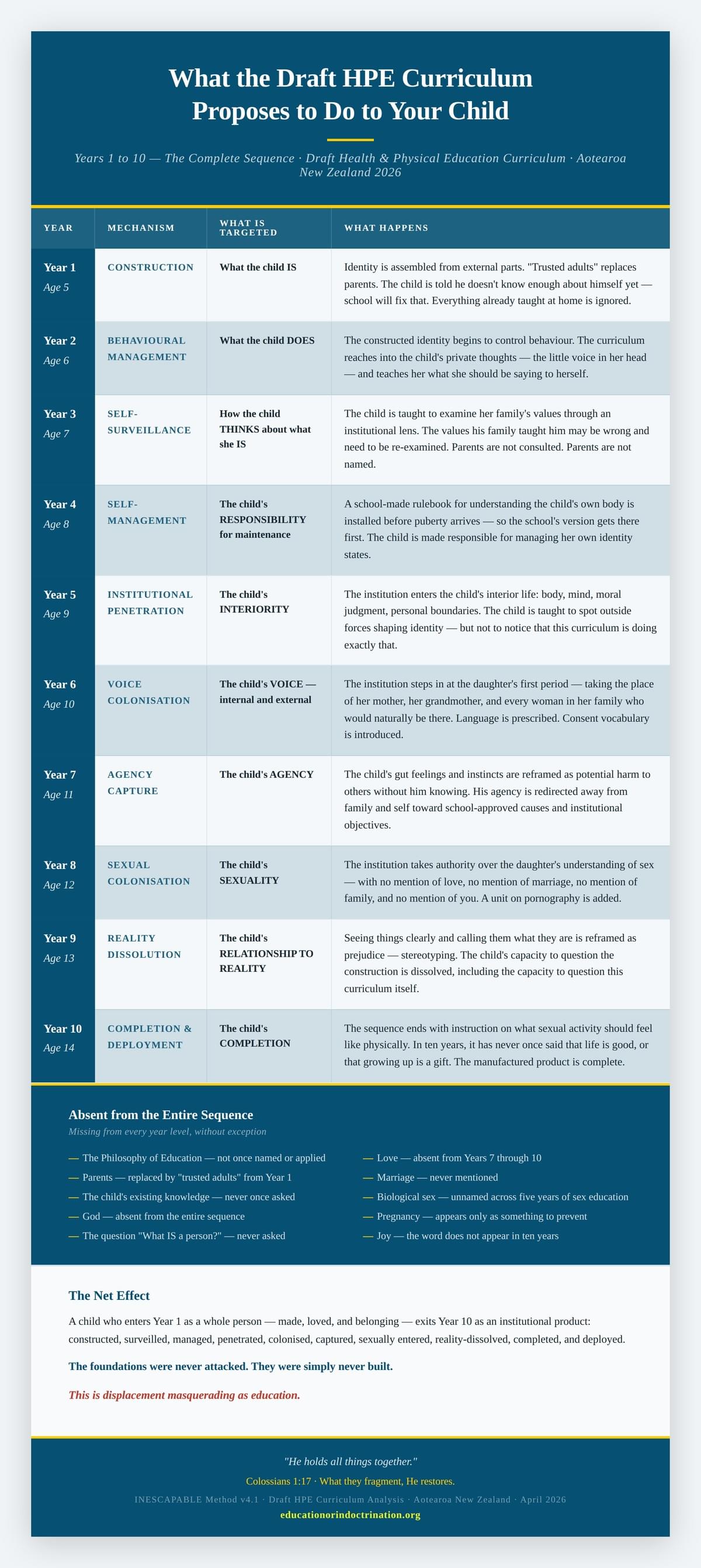
Contact
Feel free to contact me with any comments or questions.
Elisabeth Cave
Rakaia Huts, New Zealand
